Prospective Services
Practising attention in times of transition
Something is ending.Not just changing. Ending.This is a practice-place for people who already know that, and are trying to figure out what it means for their work, their organisations, and themselves.
Orientation
At first the path seems clear.The work is familiar: problems appear, effort is applied, new initiatives, better strategy, stronger processes. When something fails, you improve it. This is how responsible people inside organisations respond, and for a time it works but gradually the terrain shifts.Effort increases, yet the deeper problems remain. Meetings multiply, initiatives come and go, and it becomes harder to tell if anything is really moving. More planning, sharper interventions, the same ground worked more carefully and still something stays stuck. Then, often through a quiet conversation or a moment of recognition, another possibility surfaces.What if the ground itself is changing?In forests, there are seasons when familiar paths disappear. Old trees fall, light reaches the floor in new places, and what felt stable begins to loosen. Fallen trunks soften slowly into soil, fungi move quietly through the wood, and what once held the canopy begins to nourish what comes next. Some space opens and new growth appears in places no one would have predicted.Something similar happens inside institutions. Practices that once worked stop producing results, then structures start to strain. Then a realisation settles in, sometimes uncomfortable, though often accompanied by quiet relief. The difficulty may not be effort, in fact, the path itself may be ending. When that becomes visible, the work changes. Attention turns toward the patterns that keep repeating, the structures that are straining, and the practices that may have reached the end of their life. Some things need to loosen, others need to be composted and endings need to be named before something new can emerge.This work is for people who recognise that moment.Through the Zone of Attention Scan, The Art of Unravelling, and Endings Matter, the work here supports people to look honestly at the systems they are part of, not to rush toward solutions, but to see clearly what is ending, what remains alive, and what may be quietly beginning.People arrive here for different reasons. Sometimes something in their work no longer behaves the way it once did or the questions they are carrying have started to change. Either way, the experience tends to follow a similar shape. The old path fades, the forest opens slightly and for a moment you realise you are standing somewhere new, not lost, just in a clearing that wasn’t visible before.

Prospective Services is a practice-place for people navigating profound transition, individually, organisationally, and collectively.The work lives in three distinct fields, and you will find them in different places: some here on this site, some on Substack, and some at their own address. This website is the map, the place where it all connects and makes sense as a whole.If you are new here, start with The Fields. Each one is distinct and each one is a genuine entry point into the work. If you are looking for something specific, whether that is writing, tools, artefacts, or a conversation, you will find signposts to all of it here.
Fields
If you are new here, start with the fields.Each one is distinct and each one is a genuine entry point into the work. If you are looking for something specific, whether that is writing, tools, artefacts, or a conversation, you will find a path into it here.
Conversations
The time has come to take some of this out of the writing and offer it directly, in conversation with people who are living it.
Zone of Attention
Before you can meet what's happening honestly, you have to see it clearly.This field holds the sensing practice: ethical, careful attention to what is actually present in the territory you're navigating.
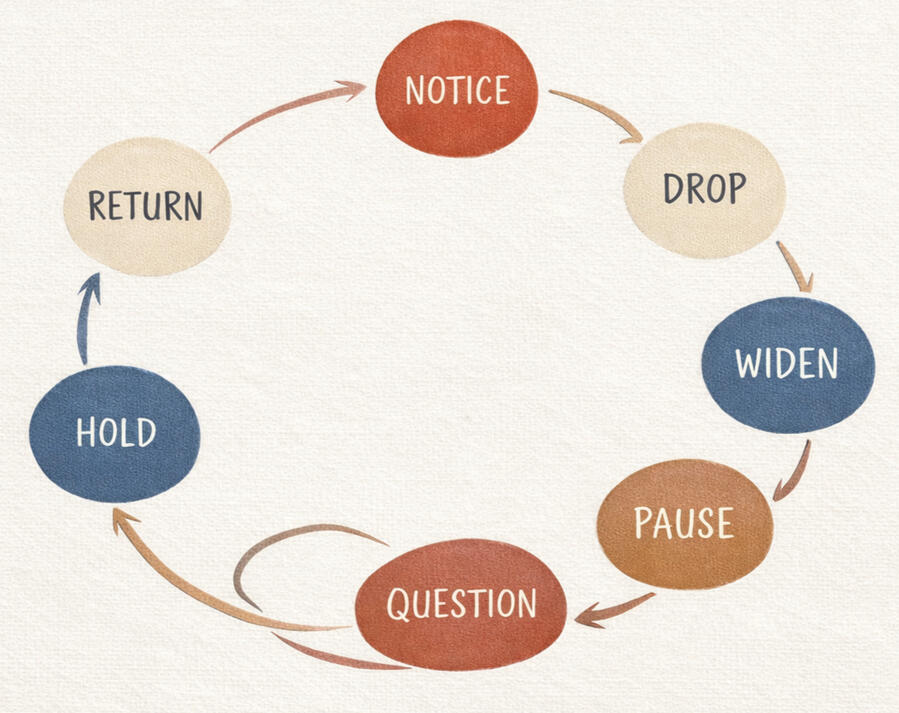
The Art of Unravelling
Modernity is composting. That process is not a problem to be solved, it is a journey to be made.This field holds the seasonal, cyclical practice of letting go with care.
Endings Matter
Endings are real. They deserve honesty, ritual, and care not abandonment.This field holds the practice of meeting endings with integrity, in organisations, in communities, and in ourselves.This field is still forming. It will open when it is ready.
The Seed Bank
Here you will find tangible tools, practices, and scans to help you sense into systems. This is where the work becomes something you can hold in your hands and take into the world.
Zone of Attention ScansThese scans are designed to help you see more clearly what kind of situation you are in, before deciding what to do. They offer structured ways into complex issues, helping you notice the wider patterns, pressures, and tensions at play.
Seasonal PracticesThese practices emerged through The Art of Unravelling on Substack: a seasonal exploration of grief, kinship, emergence, and cultural transition. These practices help us sense what is shifting within us, between us, and in the relational field around us. They are gathered here in seasonal collections. Each season carries a different quality of attention and a different invitation. You don’t need to begin at the beginning. Simply enter the season that resonates with where you are.
Lineage
Foresight and futures studies

This work is not created in a vacuum. It is grounded in years of practice and stands on the shoulders of established fields, including futures studies, death studies, grief literacy, and hospice logic.This page is a doorway to the intellectual roots of the practice.The full archive of foresight writing, academic publications, and podcast conversations lives on a dedicated Substack called Field Notes. It is an archive, not a newsletter, and is offered freely.
Zone of Attention Scanning
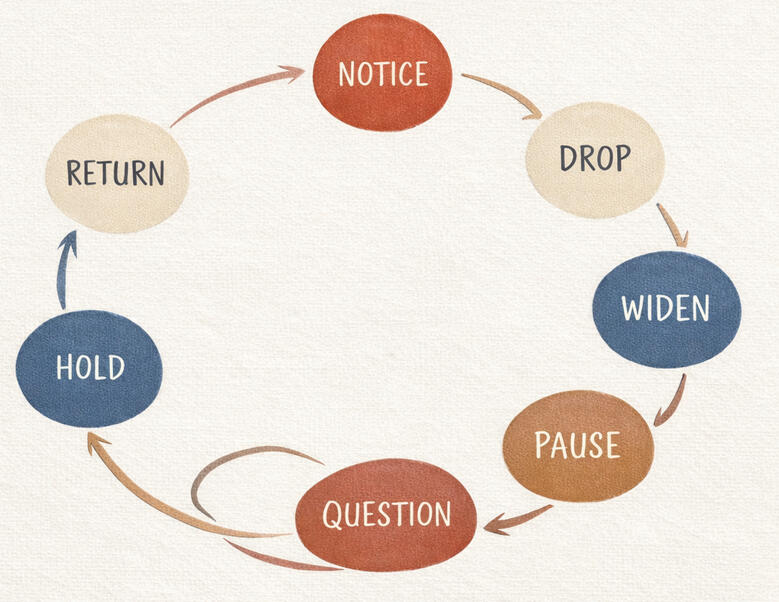
Across policy, organisational strategy, and futures work, attention has been treated as an abundant, neutral, and optimisable resource. Signals are gathered, filtered, prioritised, and translated rapidly into action. This approach assumes that perception is largely objective, that relevance can be determined without ethical consequence, and that speed improves judgement. Under contemporary conditions, these assumptions no longer hold.Zone of Attention Scanning is not a forecasting method. It is a perceptual discipline. It seeks to improve the quality of seeing before decisions are made, to slow premature closure, and to hold open space for moral, ecological, and relational data that are routinely excluded from strategic sensemaking.
What is the Zone of Attention?
A Zone of Attention Scan maps what is actually present in the territory you are navigating. Rather than generic trends or static frameworks, a scan gives you a curated view of the live questions, tensions, and possibilities shaping your specific context right now.The scan draws on publicly available research, policy documents, blogs, and critical scholarship across multiple domains. It uses Causal Layered Analysis (a futures methodology developed by Sohail Inayatullah) to move from surface signals to deeper structures, worldviews, and myths.There are three ways to engage with the Zone of Attention work: the free scan summaries, buy the full scan or commission a tailored scan on the topic for your organisation.
Tailored scans
Sometimes a generic scan is not enough. If you are navigating something specific to your organisation, its history, its constraints, and its particular position within a live issue, a tailored scan can be written with your context explicitly in view.Tailored scans on an existing topic start at AUD $1,500.Bespoke scans on new topics are quoted separately.If you are interested in a tailored scan, please use the form below and I will come back to you within 3 business days.
Work with me
The time has come to take some of this out of the writing and offer it directly, in conversation with people who are living it.
You might be sitting on a decision: a restructure that's coming, a team you're about to lose to budget cuts, or projects that need to end because they're no longer relevant or because the direction has changed. Perhaps you're grappling with how to bring change into an organisation when everything you try at the surface level isn't working, when the effort is real and the outcome still isn't there.You may be just tired in a way you can't explain, and the usual conversations, the ones about performance and strategy, aren't getting anywhere near it.I bring the thinking I've been doing in public, you bring the tensions and decisions you are facing with the weight of carrying them. What we make of that together isn't decided in advance.I suggest each engagement runs across three sessions: a beginning, where we find out what's actually here, a middle, where we work with it directly, and an end, where we take stock of what's shifted and what hasn't.The structure gives the conversation room to develop rather than driving it towards a result.
If you are not sure, book a fifteen-minute call first and we'll talk through whether it's the right fit.
If you already know, book straight in.
Sessions are AUD$250 each. You can book up to three sessions, and each one is paid in full at booking.
Melbourne, Australia
About
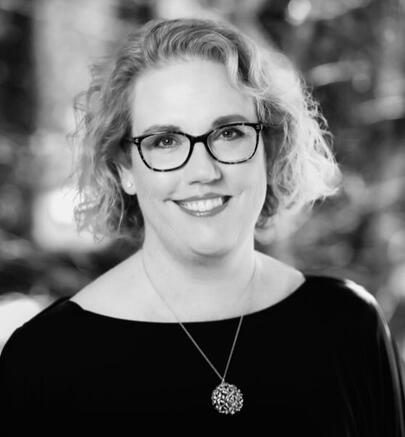
My work and writing sits at the intersection of foresight, organisational life, and cultural transition.For more than twenty years I have worked with leaders, learning communities, and institutions navigating periods of growth, strain, and change. My background spans leadership development, organisational culture, palliative care, and systems thinking. Each of these fields shares a common concern: how people make sense of complexity when the ground beneath them is shifting.My focus is now on helping individuals and organisations develop the capacity to pay attention well in times of uncertainty. Through practices such as Zone of Attention Scanning, I support you to notice emerging patterns, question inherited assumptions, and orient yourself to the unfolding conditions.Alongside this organisational work sits a deeper inquiry into endings, grief, and cultural transition. Through Endings Matter and The Art of Unravelling, I explore what it means to live through periods when familiar systems, identities, and narratives are coming to an end, and how these moments can be met with care rather than denial or premature solutions.Across these different strands runs a common thread. In times of profound change, I believe prediction becomes less useful than attention. Learning how to stay present to endings is often what allows genuine emergence to take place.My work draws on traditions of foresight, complexity theory, ecological thinking, and grief literacy, as well as the practical wisdom that comes from working closely with people at moments of transition.I live and work in Australia on the lands of the Wurundjeri people.